Monthly Archives: September 2019

Deliberately Leaving Spaces

Even young readers can be trusted to make their own meaning from the stories they read

There is a difference between leaving spaces that invite the reader into the story, allowing them to make up their own minds about events and characters; and leaving gaps in the narrative.

Obviously different readers want different levels of ownership and involvement with what they read. The more imaginative they are themselves, the more they want the freedom and excitement of being invited in to be part of the story. They want to immerse themselves in the actions, the emotions and the lives of the characters without too many interruptions for extra details. They want to cut to the chase, and be trusted to either go back or pass over anything that they don’t immediately understand. Other readers want more spoon-feeding. They want everything spelled out in black and white with no room for questions, doubts, surprises. Catering for different types of readers requires a delicate balancing act on the part of the writer.

Every author and publishing house needs to sell books. And each book must have, not only a powerful story to tell, but a unique way of telling that story. To engage as many readers as possible there must be a certain amount of trust that develops between the reader and the writer. The spaces deliberately left in the text must work for as many and varied readers as possible. Those who want to enter into the story, and see at least some part of themselves reflected there, and those who would rather all the ends were tied up tight. For me it’s a tight wire act that requires, skill, restraint, passion and a good dollop of patience. The last thing I want to do is simply satisfy the expectations and conventions around stories for young people. I want my readers to finish the story with some questions still to ask, some scenes that stick in their minds, ones they puzzle over. At the end of the story I want them to ask ‘I wonder what happened next?’ That way those characters, and that story, will stay with them long after they have closed the book and put it away.

I am grappling with this at the moment, putting the finishing touches on my new book, Goldfields Girl. Wish me luck.

On Our Beach?

On our beach – the real one.

Who could imagine all the sights, sounds and physical sensations of a summers evening on Cottesloe Beach inside the Spare Parts Puppet Theatre in Short Street, Fremantle? Certainly not me.

In spite of seeing the Spare Parts creative team pull off many miracles over the twenty or so years I have been associated with them, I really struggled to visualise just how they could simulate an interactive beach experience for audiences, ranging in age from 5-95, in their latest show, On Our Beach. Having read the pre-publicity and noted that the audience would not  be seated, and that I would be asked to take off my shoes and socks, I was driving down the coast towards Fremantle with no idea how this would work. The wind was coming straight off the frozen wastes of Antarctica. Showers of squally rain were beating against my windscreen and the heating inside my car was turned up high. For the first time ever, I wasn’t looking forward to going to the Spare Parts Theatre. ‘What were they thinking?’ I was asking myself ‘Proposing a day at the beach in September when there is at least a 50/50 chance that the weather will be foul.’

An hour later I had watched the sun set over the water while resting on my beach towel, played beach volleyball, had a barbecue (inedible) and been ‘swimming’ along with about fifty other people, young and old, all totally engrossed in the shared experience. The Spare Parts team has done it again!

On Our Beach, at 1 Short Street, Fremantle until October 12th, has to be seen to be believed.

The Responsibility of Fiction to History

Historical fiction titles by Elaine Forrestal

As a lover of both fiction and history I am very keen for these literary siblings to live harmoniously together. But, as in all families, niggling differences of opinion get in the way of harmony and an unwillingness to compromise often prevents the insight needed to move forward. With one party insisting on hard evidence and the other side claiming that accessibility is the key needed to unlock any real understanding of that evidence, the arguments go round in ever decreasing circles.

Is it better to publish the bare facts and consign them to a life of gathering dust on a shelf somewhere? Or to tell the story, filling in the obvious gaps based on our thorough research into the character and the era in which they lived, in order that the essential truth of the story can reach a much wider audience? There are lessons to be learned from the mistakes of history, but it takes a sprinkling of fiction to bring those lessons into sharp focus and encourage a much wider spread of people to access them. In this way we can at least hope to learn those lessons and avoid, as far as possible, making the same mistakes again.

The questions posed by our past will not even be debated, let alone answered, unless history is told in a way that engages the young reader. These are the readers for whom the last century is already as remote as the Middle Ages. How will they avoid making those same mistakes again if the stories they need are trapped inside dry and dusty tomes. We must, at the very least, make them aware of the wealth of knowledge and information available in a fictional format. The same information – just in a different wrapper.

Letters from Readers of Someone Like Me

As I was preparing to celebrate Someone Like Me being continuously in print for 21 years with Penguin Books Australia (now Penguin Random House) I got out my Scrap Book file and started to re-read some of the letters that kids, and sometimes parents and teachers, have written to me. They are, of course, fascinating!

From quaint handwritten and illustrated ones to the more recent emails, some just a few lines long, others a page and a half, they are all precious. Some are barely legible, written in pencil with invented spelling or emailed in texting language, but I have made it a firm policy to reply to each one individually within 24 hours – if humanly possible. I value this interaction with readers. They so often have interesting things to say and sometimes give me ideas for future stories. Some of those letters have become the starting point for friendships  or mentorships that have lasted for months, even years. In one case a teacher from Victoria, who had been reading Someone Like Me to his classes each year for several years, was coming to Perth for a brief visit. He arranged to meet with me over coffee, and brought with him several copies of the book to be signed for himself and the school. He had also had requests from his students to bring back photographs, just to prove that he had actually met me and wasn’t pulling their legs.

I treasure these letters and bundles of them are now held in my personal archives at the Battye Library, where anyone can read them. But it wasn’t until last week that I became aware of just how many lives this book has touched in the last 21 years. Fingers crossed that it will continue to do so for many years to come.

Capturing a Character’s Image

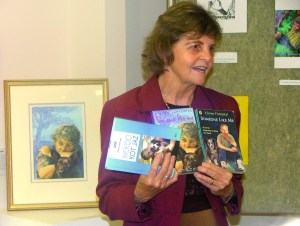
Elaine Forrestal with a range of cover roughs and artwork for Someone Like Me

It’s hard to describe the feeling when you first see the cover image of your new book. You live with your own images of the characters running around in your head for so long. While you are writing, editing, re-writing, you are dreaming, imagining, seeing them in your mind’s eye as they face the dangers and carry out the tasks required for their story to be told. Then suddenly there it is – someone else’s version of the person you have got to know so intimately.

Early on in my writing career, while I was still in the ‘short stories for very young children’ phase, I made a couple of attempts at illustrating my stories. But I quickly realised that, for me, the words created the pictures. My bundle of colouring pens and aquarelles could only produce a stiff imitation of the lively, active and well rounded characters who already existed in my head. So when I saw, and fell ion love with the first cover images for my new book, Goldfields Girl, there was a mixture of pride and amazement. Someone else had seen the same dominant features in Clara as I had. There she was looking larger than life, standing in the wide Coolgardie street in 1894. Strands of hair had escaped her ‘do’ and blown across her face as she stares out at the reader with a mixture of inner strength and determination, and just a dash of sadness around her full lips. It is easy to see that she is a complex character, larger than life, but vulnerable deep down.

I can’t actually show you the roughs just yet. Marketing departments, distributors, book shops and other interested parties have still to be consulted. But stay tuned. It won’t be long now.