Category Archives: Uncategorized

That Goldfields Life

Bonnie (aged 5) and Cassie Ives in the back garden of 4 Stanmore St, Shenton Park

During the interactive part of my author talk to the Booragoon Rotary Club last week, I became conscious of just how many people in Western Australia have a personal connection to the goldfields, either through their ancestors or their own experience. In spite of its isolation and the discomforts of heat, dust and flies there seems to be some sort of magnetism about the area. Certainly in the late 1890s people from all over the world flocked to the diggings in and around Coolgardie, and Kalgoorlie. Some of them moved on quite quickly, finding the work and the conditions too daunting. Others stayed forever, initially lured by the thought of striking it rich, then finding the camaraderie and the relative freedom of the outback more to their liking than city living.

My own maternal grandparents spent the first year of their married life living in a tent in Kalgoorlie. In the family archives we have a photograph of the two of them standing proudly in front of their own canvas dwelling with its white picket fence and small patch of grass out the front. That patch of grass was the only one amongst the rows of tents. My grandmother’s small, scraggly patch of grass was hard won. Determined to grow something to relieve her grim surroundings, she saved every drop of pre-used water to keep it alive.  At that time tents were the only affordable dwellings. Even bush huts were few and far between. The few natural trees had already been scavenged from the surrounding countryside. Transporting building materials was slow and expensive. Only the very rich, or the official Town buildings, could afford weatherboard or stone. My grandparents  survived, living in Kalgoorlie until my grandmother fell  pregnant. Then they moved to Perth and bought a block in Shenton Park.  My grandfather proceeded to build them a house. They camped in one room at first while he virtually built the house around them. My aunt was born and, five years later, my mother. One of her earliest memories is standing beside her father and passing him the nails as he added another bedroom to accommodate his growing family. Although they never returned to Kalgoorlie, the goldfields left an indelible mark on their lives, as it has done to so many others.

Novels Do Not Lie

Elizabeth Macarthur, in her eighties

At the beginning of Kate Grenville’s new book, A Room Made of Leaves, the long awaited follow-up to The Secret River, the editor explains that ‘this book consists of recently rediscovered notes towards a memoir written by Elizabeth Macarthur, wife of John Macarthur, who is widely recognised as the founder of Australia’s wool industry.’

However, Kate Grenville’s Afterword proudly proclaims that this is a sham. ‘There is no box of secrets, found in the roof-space of Elizabeth Farm.’ Even though Mrs Macarthur spent much more time on the farm than her husband did and could easily have hidden her most personal and private  diaries and letters there. The author makes no apology. In fact she seems to relish the opportunity to thumb her nose at the hide-bound historians who have failed to recognise a truth that novelists have long acknowledged: ‘That all writers are liars. Biographies, by a necessary selection of facts, may be called lies. But novels do not lie. Having other purposes, a novel can effortlessly, even unconsciously, hold the truth in its shadows’ (Jessica Anderson, Sydney Morning Herald, 30th November 1996)

I know this is a favourite hobby-horse of mine, but I want to congratulate Kate Grenville on being brave enough to make this point unashamedly, in fact almost with glee.

Speaking to an Adult Audience

Rebecca Higgie, Dianne Wolfer, Elaine Forrestal talking about combining history and fiction

As a former Early Childhood teacher I am very comfortable with talking about my work to young  audiences. Speaking to adult audiences is a bit more challenging for me. I have been asked to talk about Goldfields Girl, for 30 minutes, to the members of a Rotary Club. The question, ‘What will I say?’ springs immediately to mind. ‘What will my audience want to hear?’

Having done the research and worked through countless drafts of the book I have plenty to say. But what will my audience want to hear? How will I keep them interested and engaged for 30 minutes? I can tell them snatches of the story, but it is 240 odd pages long, and in any case they can read all that for themselves in the book. What they will want to know is why, when and how I wrote about Clara Saunders.

I have already put together the mandatory Powerpoint – pictures only so that I can adjust the length of my presentation. Skip over bits that don’t seem relevant to this particular audience, dwell on the parts that interest them most, the parts they ask the most questions about. But how do I get started? In this case I have thought about my audience and decided that I will introduce myself, then ask them a question to break the ice. I will ask them to tell me, by a show of hands, how many of them have family members who lived in the Coolgardie/Kalgoorlie goldfields area? It seems that everywhere I go at the moment people come up to me and tell me about their relatives who were prospectors, so the ice-breaker question should lead to lots of interaction from the audience – I hope. Ahead of time I will write down and rehearse a sentence to follow the ice-breaker. Probably something about how Clara, at 14 years of age, travelled for three days out into the desert to live and work among a fluctuating crowd of rough and ready prospectors. After that I will have to let Clara’s story tell itself, being aware as I do of the atmosphere in the room and the interest level of my audience. In other words wing it, and hope for the best, always being able to adjust the length, to dwell on some parts and skip over others, as time dictates. Of course I will be slightly nervous, but I will tell myself to relax and enjoy the company of interested people. Wish me luck!

By the way the Fremantle Press podcast about combining history and fiction, with Rebecca Higgie, Dianne Wolfer and me, came out this week. Here is the link:https://www.fremantlepress.com.au/c/news/11615-podcasthistoricalfiction

What to Write when you Don’t Know What to Write

A single toadstool can spark so many ideas

I was staring blankly out of my office window, thinking about everything and nothing, and feeling like a kid in school again. Remembering that feeling of despair when the teacher has set your class the task of writing a story by the end of the period. ‘But Miss, I don’t know what to write about,’ I complain. ‘Of course you do,’ she tells me. ‘Everyone has a story to tell.’

I’m still gazing out of the window and suddenly there it is – a tiny toadstool. I’m sure it wasn’t there an hour ago. Or perhaps it was. Has it just pushed itself up, pristine white and shiny, out of the soil of my chaotic forest of a back garden?  Or has that heavy shower of rain we’ve had washed it so clean that it’s just caught my eye? That single toadstool standing perfectly straight, all alone amongst the leaf litter and wood violets, sends me off on a fairytale journey. There are so many questions in my head now. Like who lives in this single toadstool in the middle of a wilderness? Is it a tiny elf or wizard? Is it a crusader beetle setting off to do battle with a whole army of snails who are invading his territory? Perhaps one of those snails is on an impossible quest to find the perfect green leaf. Will it shelter for the night under the pure white roof of the toadstool. Or is that roof gleaming so brightly really a trap for weary travellers, luring all unsuspecting creatures into the poisonous interior of the toadstool?

So many ideas come from simple moments of surprise, if you let your imagination roam for a while and you are willing to try out the possibilities. The Tim Winton Awards for young writers are a great place to experiment with ideas. The annual competition is open for entries from Monday 20th July to Friday 14th August, 2020, at 5.30pm. For more information go to: http://www.subiaco.wa.gov.au

Love to Read Local Week – er, Month

Elaine Forrestal with Paddy Hannan and Love to Read Local logo

In these strange and unpredictable times a week can easily turn into a month and a celebration can look very different from the one the organisers had imagined. Love to Read Local Week was originally planned to celebrate the work of authors on WritingWA’s Literati List. The team at WritingWA had lots of hands on and face to face activities in mind to highlight the depth of talent we have in our writing community. But, ‘The best laid plans of mice and men …’ as Rabbie Burns would have said if he had been here, ‘ … must surely gang a’wry.’ In marched covid-19 and took over  the known world. However, always innovative, WritingWA pressed on with their week of  celebration and it  blossomed – even expanded – into a whole month.

So check out the fantastic books of all the WA authors on the Literati List at WritingWA.org. including my new historical fiction, Goldfields Girl. In it you will find, among other things, the true and verifiable story of how 14 year old Clara Saunders gave up her own room, at a time when the Exchange Hotel in Coolgardie was already full, to an ailing Paddy Hannan. She could see that he needed somewhere to rest while he battled the deadly typhoid disease that had already killed so many of the prospectors in the town, which was itself barely clinging to life on the edge of the desert. This was in April 1893, before Paddy Hannan had made the most significant discovery of his life. The whole story is too long to tell here, but imagine how different the history of Western Australia would have been without the discovery of the Golden Mile.

Explore the Literati List, including Goldfields Girl, (Fremantle Press, 2020) and all the other fantastic stories by WA authors at: ltrl.writingwa.org

MYOSB? What is it?

Anthology of the prize winning short stories from the 2019 Tim Winton Awards

In a battle of the acronyms, MYOSB and TWA have defied covid-19 and are both hale and hearty, up and running and ready to support our young writers and illustrators. Their 2020 programs are delayed, but not defeated, and talented West Australians of school age have the chance to get their creative juices flowing again and enter both the Make Your Own Story Book competition and the Tim Winton Awards for young writers.

And bring out the cheer squad for all those dedicated professionals who will once again, in spite of exceptionally difficult circumstances, run these two important competitions. Make Your Own Story Book entries involve both writers and illustrators. Illustrations for your book can be made by painting, drawing, collage and even photographs, as long as they are taken by the author or illustrator of course. Books must be complete with sturdy cover, blurb and author biog. Over the years that this competition has been running the judges have been amazed by the skills, the  innovation and diversity these young people have shown in producing unique handmade books – works of art in their own right. The Tim Winton Awards are perhaps better known, but in that case only the quality of the writing is judged. Of course the presentation of the short story entries also has to be of good quality. Surface features such as spelling, punctuation, grammar and neatness need to be of a standard that makes them easy to read and does not distract too much from the impact of the ideas.

So get out those pens, pencils, paint brushes and computers kids. There are prizes to be won and perhaps careers to be had. Shaun Tan famously won the MYOSB Award when he was 11 years old. And if you are a prize winner you will get to meet another world famous WA author; Tim Winton who is the patron of the Awards that bear his name. He presents the prizes to all of the successful entrants each year.

And, hot off the press, congratulations to Shaun Tan! He has just won the Kate Greenaway Medal for his picture book, Tales from the Inner City. This is one of the most prestigious children’s book awards in the world! You do us proud, Shaun!

Building Towards a New World

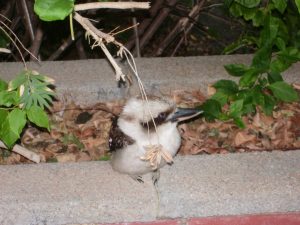
A baby kookaburra facing the new world

We have at least one thing to thank covid-19 for. It has revitalised our neighbourhood. We live a stone’s throw from the Dog Beach in Scarborough, and because we are situated right on a T-junction we have always had an interesting collection of people and their dogs walking past. But it is only since lockdown, with people working from home and kids doing their school work online, that we have actually got to know our more recently arrived neighbours. During the most severe period of lockdown a section our front fence fell down in a storm. Our very generous neighbour from two doors up was the first to offer help. ‘Give me your tip pass and I will take the bricks away on the back of my truck,’ he said. When I protested that I couldn’t possibly take up so much of his time, he said, ‘No problem. I can’t go to work, anyway.’ And his wasn’t the only offer of help. People we have known for years, and others who have just moved in to our neighbourhood, are looking out for each other. They distribute their home baking, chat in driveways and walk their dogs together. It is obvious that months of isolating restrictions have not left them looking for more of the same. Now they are looking for reasons to make contact with each other, even if it involves some heavy lifting.

Mark O’Connell, in his new book, Notes from Apocalypse: Journey to the end of the Earth and Back, points out ‘The importance of accepting that the world is always ending … and realising that  doing (whatever it is we do) is the first step towards building a new one.’

Whether our personal apocalypse is coronavirus or climate change or something we haven’t even encountered yet, I for one don’t want to lock myself away in a concrete bunker with a stockpile of food and  military weapons. I would much rather take my chances out there, still in contact with people, and beginning to  build a new world one tiny step at a time.

I’ll see you out there.

September too far away

Elaine Forrestal’s parents lived through two World Wars and the Great Depression

At last the shackles are coming off and we can start living again! David Wickham, arguably Australia’s best accompanist and keeper of our classical music, has raised the flag and put his head above the covid-19 parapet. He has just announced dates, times and venue for four live concerts to be held in September, and I for one am cheering him on. Every year David puts together a series of concerts called Swan Songs. These involve professional singers, many of them local, all of them top class, some with overseas reputations. The concerts are intimate. This series will be held in the atmospheric Christ Church, Claremont with David accompanying on the magnificent Church piano. His playing has a special magic of its  own that brings out the best in each soloist. I can’t wait to take off my work clothes and put on something more festive on those four Sunday afternoons. But what will the brave new world be like? Have we been spooked by our encounter with the vast unknown? Have we grown timid after months in lockdown? Having been forced to distance ourselves, will we have forgotten how to look each other in the eye and share genuine emotions, without the protection of the ubiquitous online screen? Will we retreat and choose isolation? Or will we go forward, nothing daunted, and embrace all the new and exciting challenges out there?

At the moment September seems too long to wait, but I can faintly hear my mother saying, ‘Possess your soul in patience’. Or my father, much more tongue-in-cheek, ‘Patience and per-siv-erence made a Bishop of His Riv-erence.’ I never really got the hang of either of those while I was a child, but I agree they are more thought provoking, and probably more effective than ‘Just wait will ya!’

Don’t Judge This Book by its 80yr old Cover

‘Don’t judge a book by its cover’, I was told when I was young. I am no longer young – except at heart – and neither is our famous solo round-the-world yachtsman. But, like me, he refuses to count his life in years. He continues to do what he can do and enjoys the life he has, rather than worry about what others say he shouldn’t be doing at his age. So where is Jon Sanders during this world wide covid-19 pandemic? On the island of Saint Martin in the middle of his 11th solo voyage around the world. Try telling him to stay locked down at home just because a clock somewhere has ticked over and he is officially 80 years old and therefore no longer the person he was one minute before. He is expected to keep his social distance and no longer have a drink in a crowded bar or a meal at the cafe, with friends, after spending long hours repairing his yacht Perie Banou II, ready to continue his journey.

Jon Sanders on his 11th solo voyage round the world

We know that time is a human construct anyway. The world has its own rhythms and, in earlier times, human beings lived by them. When the sun went down people went to bed, and got up again when it was light enough to work. When the temperature dropped and the rains came it was time to plant seeds. When the weather grew warm and dry again it was time to harvest what had grown. There were exceptions, of course. In the tropics the rains come in summer and the winter months are dry. Oops! I’ve just used a man-made measure to describe something – months. Our chronological system was invented for convenience in the first place. But even in the most regulated society there has to be room for exceptions.

Let’s enjoy what freedom we have. You never know when it might be snatched away.

Children’s Writers – Live

Elaine Forrestal, storyteller and writer

“For TV and film you just have to be,” Hugo Weaving said when interviewed for The Australian Review Magazine recently. “Stage is different. While developing the character you move from it being outside you to being inside you – absorbed into your personality.” Storytellers, who are often story writers, work in much the same way.

Performing your story for a live audience will alert you to what’s working and what’s not. When you tell a story over and over, to different audiences, you change things. You add words in, leave others out, change the rhythm, gestures, timing. You gauge what works by the responses of your audience. At which points do they laugh, shout out objections, wipe a tear from their eye? The best bits are stored away in your mind, ready for the next time you tell that story. Any live performance is like a stream flowing. It moves from one place to another. While it always looks the same on a map, it is incrementally changing as it picks up grains of sand and drops them in a different place. And even as it moves through patterns of light and shade, it will not lose the essential character of a  stream. It will take time and  more than one telling for a story to fully develop. The storyteller will adjust the pauses, the gestures, the emphasis on certain words and phrases. They will adjust the pitch of their voice at different points to bring out the inherent humour, drama, sadness,  and special magic of that story. Each audience will have a lasting effect, not only on the storyteller, but on the story itself. These incremental changes will become part of the story and continue to be carried by the memory-stream, kept for future reference. Of course the interplay between audience and performer is not without risk. Sometimes it all goes wrong. But those times are also crucial to the life and growth of the performer, and of the story itself.

One thing covid-19 has taught us is the importance of live story times in our Libraries and Schools. The sooner we can reinstate them the better. Somehow Zoom just doesn’t cut it.